Disclosure: HarvestMap is reader-supported. If you buy through links on this page, we may earn a commission at no extra cost to you. As an Amazon Associate I earn from qualifying purchases.
An above ground root cellar holds produce in a mound, a stack of sandbags, or a shed, so you never have to dig. A poured concrete version goes into a hillside or tucks into a basement corner. Either one works if you hit the storage conditions: 32 to 40 degrees Fahrenheit and 85 to 95 percent humidity, per The Old Farmer’s Almanac.
Below you’ll find materials and rough costs, the build steps for each style, the mistakes that ruin a crop, and a comparison table. For a poured build, see How to Build a Root Cellar.
What You Need (and What It Actually Costs)
For a concrete root cellar, gather concrete, footers, rebar, plastic sheeting, plywood forms, insulation, an insulated door, and cinder blocks if you’re building stairs. An 8 x 8-foot cellar takes roughly 350 cinder blocks for the walls, according to ShunTool. One large project used about 21 cubic yards of concrete. Wire 10mm rebar in a 2 foot grid pattern, with extra around the door, per A Traditional Life.
An above ground root cellar or no-dig build swaps most of that for sandbags, straw, dried leaves, and a thick wooden lid. A pit-style version uses a garbage can or similar container. Dig a hole slightly larger than the diameter of the can, deep enough that the lid sits 4 inches above the soil level, per The Old Farmer’s Almanac.
What It Costs
Cost varies more than any other part of this project. Concrete, equipment rental, and site work drive that spread. Budget for an insulated floor hatch or entry door, and pick up reference books such as Build Your Own Underground Root Cellar or The Complete Root Cellar Book.
The Precast Shortcut
A manufactured concrete unit skips the pour entirely. One model measures 16’2” L x 7’ W x 7’ H and weighs 25,959 lbs, per Bonner Concrete. Each root cellar gives you approximately 462 cubic feet of organized underground storage. It comes with preformed concrete steps, an aluminum hatch door with strut assist, vent ports, and electrical conduit, according to Bonner Concrete. Pricing is call-for-availability, so request a quote instead of guessing at a number.
Step-by-Step: Building It
Pick the style before you order anything. Above-ground root cellars use a mound, sandbags, or a shed. A concrete root cellar gets poured into a hillside or set into a basement corner. That choice drives every measurement that follows.
Site, Dig, Form, Pour
For a precast unit, dig a hole 15 feet long by 9 feet wide with a maximum bury of 2 feet, per Bonner Concrete specifications. For a pit cellar, dig a hole slightly larger than your container and deep enough that the lid sits 4 inches above soil level, as the Old Farmer’s Almanac advises. If your winter temperatures drop below 25°F, dig deep enough that all crops sit below the soil’s surface.
Complete forms for all four walls with rebar and block-outs for the door and vents. Wire 10mm rebar in a 2-foot grid pattern, with extra reinforcement around the door. Bend rebar up into the roof forms to tie wall and roof together.
Ventilation, Access, and Finish
Add two 4-inch vent holes and an insulated exterior-grade access door. For a basement build, plan 4-foot footings with dirt backfill. Packed earth is the preferred flooring for outdoor cellars. Set shelves 1 to 3 inches away from the walls so air can circulate and mold stays down.
A basement slab alone won’t work. A bare slab gives you no enclosed, vented air pocket, so it can’t hold the cool, humid conditions produce needs. Build the room.
Mistakes to Avoid
Ventilation and water
Skip ventilation and you lose the crop. Without intake and exhaust vents, ethylene gas spoils produce and mold takes hold. For a basement retrofit, plan 4 foot footings and dirt backfill.
Drainage decides whether a pit or hillside cellar survives its first wet winter. Dig only where soil is sandy and well draining, and use an elevated slope so water runs away from the pit as it moves downhill. If your ground is heavy clay, don’t dig there. Build a mound or sandbag cellar above grade instead. Digging deep does give you stable temperatures, but a flooded pit stores nothing.
Depth, air gaps and the slab question
In cold climates, shallow digging freezes the crop. If winter temperatures drop below 25°F, dig deep enough that all crops sit under the soil’s surface. Temperature stability isn’t complete until about 10 feet deep, so treat any shallower pit as a cold-climate compromise.
Shelves pushed flat against walls kill circulation and invite airborne mold. Keep shelves 1 to 3 inches away from the walls.
A concrete slab alone gives you no cool, humid air pocket. You need an enclosed, vented space to make it work like a cellar. Skip the bare slab.
Before you pour, confirm permits and structural support. A large build can take about 21 cubic yards of concrete, so a failed inspection is expensive.
Cost and Time Summary Table
Use this table to compare the five common builds before you commit a weekend or a budget. Costs are described in ranges, and every capacity figure comes from the sources named.
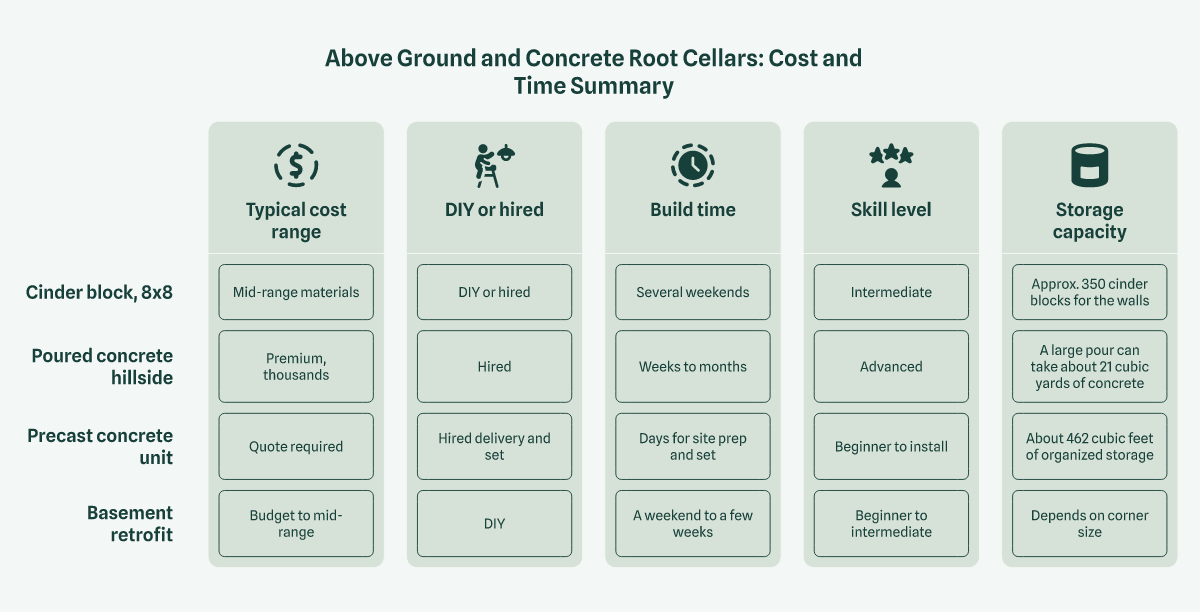
| Build | Typical cost range | DIY or hired | Build time | Skill level | Storage capacity |
|---|---|---|---|---|---|
| Cinder block, 8x8 | Mid-range materials | DIY or hired | Several weekends | Intermediate | Approx. 350 cinder blocks for the walls |
| Poured concrete hillside | Premium, thousands | Hired | Weeks to months | Advanced | A large pour can take about 21 cubic yards of concrete |
| Precast concrete unit | Quote required | Hired delivery and set | Days for site prep and set | Beginner to install | About 462 cubic feet of organized storage |
| Basement retrofit | Budget to mid-range | DIY | A weekend to a few weeks | Beginner to intermediate | Depends on corner size |
Two notes on reading it. The precast unit arrives as a complete set piece with steps, an aluminum hatch, vent ports, and electrical conduit, and Bonner Concrete lists pricing as call-for-availability, so treat that row as “quote required” and get the number before you dig.
For an 8x8 cinder block cellar, ShunTool reports approximately 350 cinder blocks for the walls, and a large poured project used about 21 cubic yards of concrete. If your site drains poorly or sits on a slope, add excavation and drainage to the timeline. For a fuller material list, see How to Build a Root Cellar.
FAQ
How cold does a ‘root cellar’ have to be? Can it be a few degrees warmer than just above freezing?
A working root cellar holds 32 to 40 degrees Fahrenheit and 85 to 95 percent humidity, according to the Old Farmer’s Almanac. Missouri Extension lists 32 to 40 degrees Fahrenheit for most stored crops. A few degrees warmer than just above freezing sits inside that band, so yes, it can work. Warm-weather crops are the exception. Keep sweet potatoes at 50 to 55 degrees Fahrenheit and never let them drop below 50 degrees Fahrenheit, and hold green tomatoes above 50 degrees Fahrenheit too. Onions and garlic tolerate drier air than the 80 to 95 percent humidity most produce needs.
What are some alternatives to a root cellar?
A basement corner, a buried garbage can, or a sandbag structure can all do the job. Add an insulated exterior grade access door from the basement and two 4 inch vent holes to make a basement corner work. For a buried can, dig a hole slightly larger than the can’s diameter and deep enough that the lid sits 4 inches above the soil level. A childhood farm shed used a mound of earth piled up to 3ft over buried root vegetables. For a no-dig option, see Cellar Storage Ideas for Any House.
How to build a cheap root cellar?
That range covers the whole spectrum from a buried can to a poured concrete room. Dig a hole, flare the sides so it doesn’t cave in, line it with straw and dried leaves, then cover it with a thick wooden lid and soil. Packed earth is the preferred flooring for outdoor cellars. For a full walkthrough, read How to Build a Root Cellar.
How long will vegetables stay good in a root cellar?
Storage life depends on the crop and on hitting its temperature and humidity band. Missouri Extension gives 32 to 40 degrees Fahrenheit and 90 to 95 percent humidity for the crops that keep longest, and 32 to 35 degrees Fahrenheit ideal for the coldest keepers. Get the numbers wrong and the loss is fast. Check your thermometer and hygrometer weekly rather than trusting the room to hold steady on its own.
Has anyone built a root cellar?
Yes. One documented project used about 21 cubic yards of concrete. Another 8x8-foot cellar took roughly 350 cinder blocks, according to ShunTool. If you build an 8x10 concrete cellar into a hillside, wire 10mm rebar in a 2 foot grid pattern and add reinforcement around the door. Commercial precast units exist too. One manufacturer lists a concrete root cellar at 16’2” long by 7’ wide by 7’ high, weighing 25,959 lbs, with approximately 462 cubic feet of storage space. Would you rather not pour concrete? See Storing Food Underground.
Sources
- Root Cellars: Types of Root Cellars and Storage Tips | The Old Farmer’s Almanac
- Building A Concrete Root Cellar: A Step-By-Step Guide | ShunTool
- Root Cellar - Bonner Concrete
- Root Cellaring 101: How to Create and Use a Root Cellar
- Home Storage of Fruits and Vegetables in Root Cellars | MU Extension
- How to Build a Root Cellar (with concrete) • A Traditional Life
- Vegetable Storage in Root Cellars | Cooperative Extension Service
- Root Cellar - Bonner Concrete